Summary of the project phases
- Development of a network with Chilean and Sudanese communities in Berlin.
- Organisation of workshops and events to promote the exchange of experiences.
- Identification of structures of racism and neo-colonialism from the perspective of participants from the migrant communities.
- Development and testing of educational approaches (methods, content, didactics).
- Creation of a freely accessible website for the educational methods developed.
- Dissemination of the project and its methods to interested parties and multipliers.
First workshop of the project
Post-colonial perspectives on global racism: Resistance and inclusion of migrant voices in educational work critical of racism
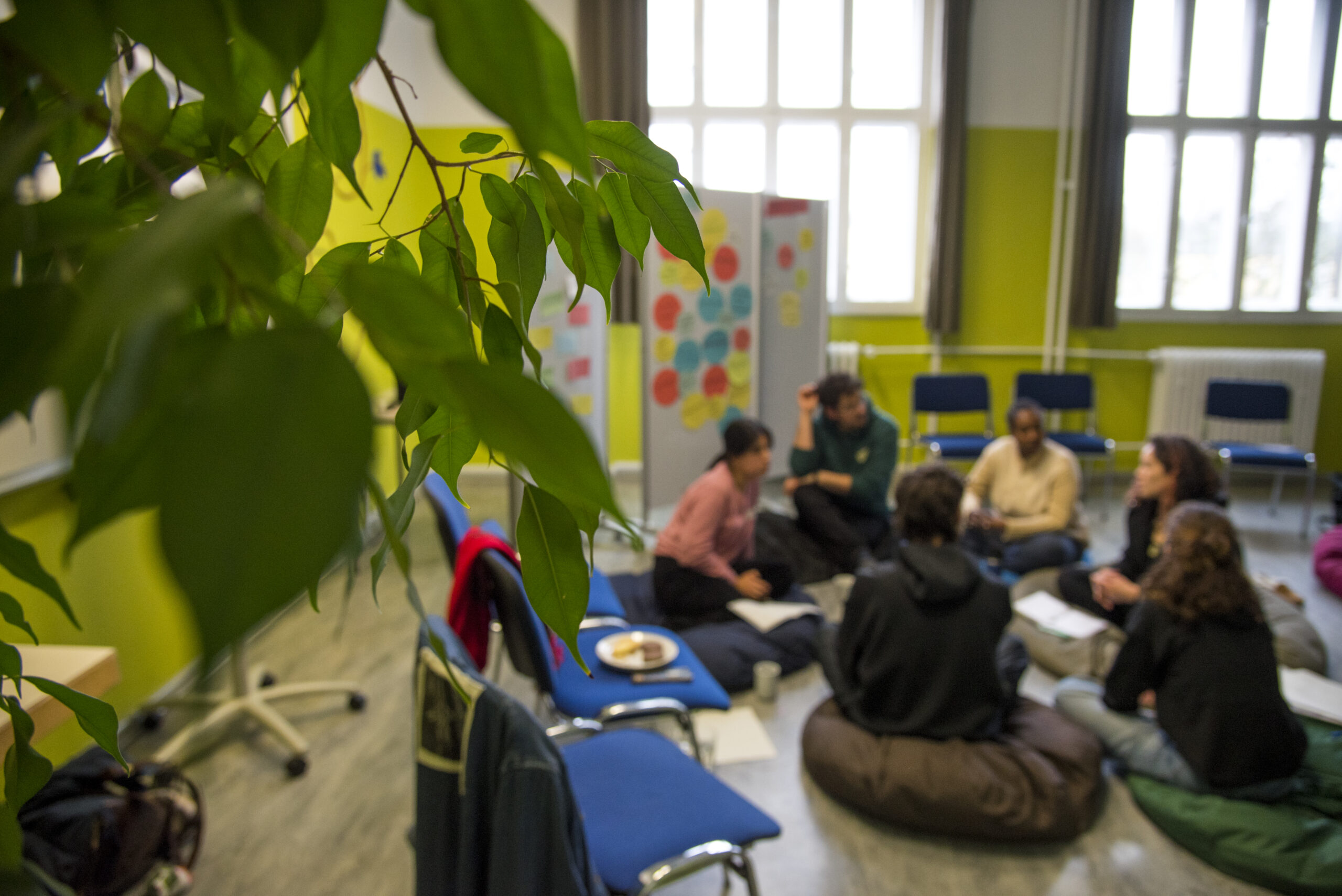
The first workshop took place on November 12th, 2022, in the OBUK organization’s building, and aimed to create space for communities to begin to get to know each other and discover the similarities and differences in the histories of our territories of origin. Through this, there is the opportunity to identify and explain from our perspectives the historical events and processes that have characterized recent social uprisings in our territories and how this is linked to historical colonialism perspective until the present. Through these perspectives, we entered into further discussions about what we understand by racism, colonialism, and its interrelationships.
We started the journey by getting to know each other through the “sociometry” activity, where we talked a bit about our stories and political experiences. Through this, we started to exchange some interesting ideas about what we understand by: “activism” and “non-formal education”. Both are concepts that we often use, but don’t often stop to understand what we mean by them.
Also present in our day was the desire to better visualize potential future networks through the ways we have to organize our struggles and communities. Therefore, in a second activity we shared about the collectives and the different ways we have had to organise politically as migrants in Berlin on various different issues, such as support for migrants and refugees, making the struggles in our territories visible in Berlin, the role of German today in various parts of the world, among others topics.
Towards the end of the day we had a interesting exercise of reconstructing history from our perspective: we collectively created a timeline of important events that help us to understand the various events that led to the latest social uprisings in Chile and Sudan.
These events are so intertwined with different areas and issues, regional and global facts, and ways of approaching them, that it is interesting to do the collective exercise of historical reconstruction. We learned from listening to our partners, as well as from the differences and similarities we could find between the contexts of both territories.
We are happy to have met and initiated the project, and excited to continue learning and sharing our experiences in order to translate them into an educational method with an important social and political impact.
Second Workshop
Heritage of colonial ruling — current postcolonial structures
On 17 December 2022, the second workshop took place in the seminar room of our seminar house from 10:00 to 18:00. The main objectives of the workshop were:
- Explore the concepts of racism/discrimination and colonialism.
- To deepen the experiences of discrimination and colonialism on a structural level.
- To link the role of Germany in the consequences of colonialism here and in our territories.
- Continue networking and exchange between migrant communities from Sudan and Chile.
Below is a summary of the key activities and discussions:
- Participants were warmly welcomed and a round was held for them to express their current state of mind.
- Participants were then asked to share with a partner and reflect on what they had learnt from the first workshop.
- This was followed by a brief summary of the first workshop and an explanation of the objectives and programme for the second workshop.
- Participants took part in open discussions to discuss the concepts of colonialism and racism from their personal perspective and explore their connections.
- Specific examples of structural effects of colonialism and racism at different levels were then discussed and recorded on flipcharts.
- After a lunch break, the discussion on structural effects continued, focussing on the role of Germany.
- The participants worked together in groups to collect methods for the further development of the project and to identify target groups for these methods.
- Finally, participants shared feedback with their partners and reflected on the day and the ideas and emotions they left the workshop with.
Identification of structures: We analysed the extent to which it was possible to identify structures that promote racism and neo-colonialism at global and regional level from the perspective of these migrant communities.
To this end, we used the fish bowl method in the second workshop for an open discussion on the topic and an initial identification of structures at regional level. We answered the following questions:
What will we understand by racism and colonialism? We focused on the exchange of knowledge and experience, listened to the perspectives and answers of the participants and collected initial ideas. We then provided some information that we had gathered in advance. We tried to supplement these definitions with what made sense to us in the workshop. (To make it more concrete, we discussed examples from everyday life and also from history).
We discussed further questions such as : What structures are we familiar with and what impact do they have in our countries? And these structures have an impact, what are the differences between Sudan and Chile?
Then we defined our topics for the development of methods together with the participants.
The following document contains a summary of the main concepts and ideas we exchanged.
Third workshop
This took place on 4 February 2023. The main aim of the workshop was to develop methods to combat racism from a postcolonial perspective. Here is a brief summary of the activities:
- The workshop started with a short welcome and followed by a warm-up game where participants briefly introduced themselves.
- Then explanation of the role of the participants and the day’s programme. We then gave a short summary of the previous workshops.
- The participants discussed their experiences with racism in Germany and identified differences in experiences between people from Sudan and Chile. They also talked about whether racism serves to divide people and other types of discrimination were also addressed.
- There was a lunch break, followed by an input on the current situation in Iran, the historical context and the feminist movement and its connection to racism and anti-Islamism in Germany.
- Then there was a short input on educational issues, followed by a discussion on the development of methods to combat racism. The participants were divided into groups and developed short, game-based modules to teach anti-racism.
- Finally, the participants discussed their approaches to combating racism in their daily lives and shared their experiences.
Fourth workshop
The “Speed Method Development Workshop (SMD)” took place on 1 April 2023. The main objective of the workshop was to review the content collected so far, to give participants the opportunity to get more involved in shaping the content collected, and to collect ideas for possible methods to convey the content. Here is a brief summary of the activities:
The workshop began at 10:30 am with the arrival of the participants, followed by a warm-up and a brief exchange about how the participants were feeling that day and what natural elements reflected their feelings in the room. This was followed by a summary of the previous workshops and an explanation of the schedule.
The participants were informed about the day’s activities and they chose the topics that interested them the most. They were then divided into groups to lead the discussion on topics and target groups.
After lunch, there was a plenary discussion, followed by the actual speed method development, in which the participants worked in groups to develop short methods for communicating the selected topics.
After the presentations of the developed methods, there was a short break, followed by a final discussion in which ideas for maintaining contact between the workshops were collected. Participants were asked to write on papers what they would like to keep in the workshops and what they could improve for future workshops. The workshop ended with a conclusion and a short summary of the ideas and feedback collected.
Fifth workshop
Presentation and feedback on the developed method
The workshop on 5 April 2023 focused on the presentation and improvement of a developed method for discussion and reflection on migration, colonialism, racism and discrimination. Here is a short description of the workshop:
The methodology consists of four different activities aimed at fostering dialogue through open questions and providing both collective and individual spaces for participants to question, reflect and discover perspectives. The methodology is designed to allow participants to learn together and for most of the work to come from them.
The main dynamic of the methodology is the journey to other perspectives, be it the journey of migration, colonialism, racism or discrimination. This journey is experienced both collectively and individually, similar to how travelling in a group offers shared experiences but also allows for individual reflection.
At the beginning, each participant was given a personal travel diary to accompany them on their individual journey. This diary should be used during the workshop to record thoughts, questions, comments and personal reflections. It also serves as a tool for the fourth activity, where participants are asked to record their personal thoughts and commitments. Participants were encouraged to actively use the methodology to develop their individual perspectives and actively shape the discussion. Now both activities of the methodology were carried out with the group in an idealised way. The workshop provided a platform for feedback and improvement of the methodology by the participants, allowing for adaptation and further development.